
A storage unit can either function like an extra room for your business or become a maze of boxes that nobody wants to enter. The difference usually has little to do with the size of the space. It comes down to how inventory is arranged from the beginning.
For Las Vegas companies storing merchandise, promotional materials, equipment, supplies, or seasonal stock, a well-planned layout makes retrieval faster and protects valuable working time. The objective is simple: every item should have a logical place, and employees should be able to find it without unpacking half the unit.
Map the Space Before Anything Goes Inside
Do not start by pushing boxes through the door.
Measure the storage area and sketch a basic layout. Identify walls, corners, shelving positions, and any areas that should remain accessible. Leave practical walking space rather than using every available inch.
This initial map becomes the foundation of your business storage system.
Create Clear Zones
Divide inventory into logical categories. Depending on the company, zones might be organized by product type, department, season, project, or frequency of use.
Keep related items together. If employees regularly need a particular product line, give it a clearly defined area instead of scattering its boxes throughout the unit.
Put Frequently Needed Inventory Within Reach
Not every box deserves the same level of accessibility.
Place regularly retrieved merchandise and supplies near the front or along an unobstructed route. Less frequently used inventory can occupy deeper areas.
Nevada Movers can assist with transporting business inventory into or out of storage, while your internal organization determines how efficiently employees can retrieve it afterward.
Build Around Retrieval, Not Just Capacity
A unit that is completely filled may technically hold more inventory, but that does not necessarily make it useful.
Leave enough space to reach shelves and individual groups of boxes. If employees have to move several heavy containers just to reach one carton, the layout is working against the business.
Label Everything Consistently
A labeling system should be understandable even to someone who did not pack the unit.
Include useful information such as product category, department, season, project, or inventory code. Avoid vague labels such as “miscellaneous” whenever possible.
For larger businesses, barcode or digital inventory systems can make tracking even easier.
Keep a Location Record
Record where each major category is stored. A simple spreadsheet can show the zone, shelf, product group, and quantity.
Update the record whenever inventory enters or leaves the unit. Otherwise, even the best initial organization will gradually become unreliable.
Use Shelving and Vertical Space
If the storage arrangement permits it, vertical organization can significantly increase usable capacity.
Shelving can keep cartons off the floor and create clearly separated sections. However, heavier boxes should be positioned safely and stable stacking practices should be followed.
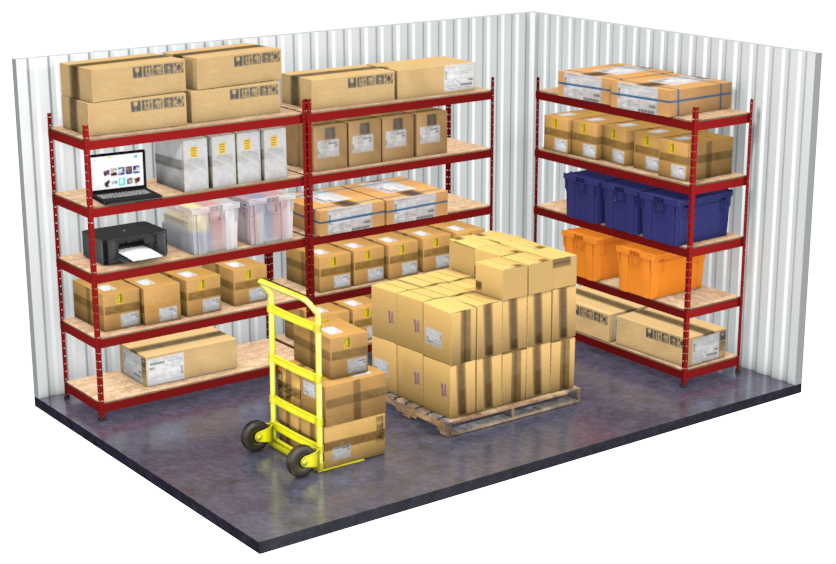
Do not stack fragile merchandise beneath excessive weight simply to save floor space.
Protect Inventory From Unnecessary Exposure
Storage organization is not only about finding things quickly. It is also about keeping merchandise in suitable condition.
Use appropriate packaging for the materials being stored. Protect items from dust and accidental impact, and avoid storing sensitive products in conditions unsuitable for their material or manufacturer recommendations.
Las Vegas businesses should also consider the region’s intense summer temperatures when selecting storage arrangements for heat-sensitive inventory.
Create an Easy-In, Easy-Out Process
The layout should accommodate new deliveries as well as outgoing orders.
When new inventory arrives, place it in its designated zone instead of creating a temporary pile near the entrance. When products leave, update the inventory record immediately.
Business storage becomes much more manageable when every movement follows the same procedure.
Use the Front Area as a Working Zone
If space permits, reserve a small area near the entrance for recently received or soon-to-be-dispatched inventory.
This prevents incoming and outgoing items from becoming mixed with long-term stock.
Plan for Transportation
Sometimes the biggest organizational challenge occurs before the inventory reaches the unit.
If large quantities of business property need to be moved from an office or warehouse, plan the loading sequence around the storage layout. Items destined for the back of the unit should be positioned appropriately during unloading rather than placed wherever there is temporary room.
Details about business storage support and related moving services are available through https://nevadamoverslv.com/.
Nevada Movers can be part of that transportation process, helping businesses move inventory while employees concentrate on tracking and organizing the stock.
Review the Layout as the Business Changes
Inventory systems should evolve with the company.
Review the storage unit periodically and look for unused space, overcrowded zones, obsolete stock, and categories that have become difficult to retrieve.
A well-organized unit is not simply a place where products are kept. It is a practical extension of the company’s operations. With clear zones, consistent labels, accessible pathways, accurate records, and support from Nevada Movers when inventory needs to be transported, business storage can remain useful even as a Las Vegas company’s stock and priorities change.